
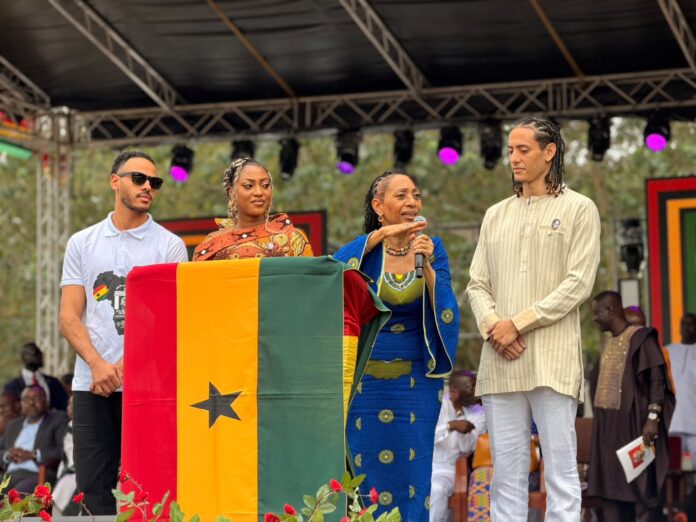

Samia Yaba Nkrumah, daughter of Ghana’s first President, Osagyefo Dr. Kwame Nkrumah, has rendered an emotional apology to the people of Nkroful for the Nkrumah family’s prolonged absence from their ancestral home.
Speaking at the 2026 NkrumahFest held at Nkroful in the Ellembelle District of the Western Region, Samia explained that the family’s extended absence was shaped by the traumatic experiences associated with her father’s political life and the upheavals that followed his overthrow in 1966.
“I want you to forgive us for staying away from our home for so long,” she said.
According to Samia, the family witnessed the enormous personal sacrifices Nkrumah made in his pursuit of Ghana’s independence, African unity and socio-economic advancement, including surviving assassination attempts.
She recalled seeing her father wounded and covered in blood after one of the attempts on his life, saying the experience left the family deeply traumatised.
“We were traumatised, we were scared, we were confused,” she stated.
Despite the painful memories, Samia said the family had now decided to return and play its part in Ghana’s development, unity and progress.
“But the good news is that we’ve come back. And we want to make a contribution to Ghana’s progress, to Ghana’s development, and to Ghana’s unity,” she said.
Samia introduced three of Osagyefo’s grandchildren who accompanied her to the ceremony, describing their presence as a source of pride for the family and a manifestation of a renewed connection with their ancestral roots.
She explained that the family’s return was not merely about commemorating Nkrumah as a historical figure, but about reviving interest in his ideas and ensuring that his philosophy continues to resonate with succeeding generations.
“We are coming back to recognize our father’s work. We are coming back to appreciate his ideas, and we are coming back to make sure that those ideas never die, but rather, they nourish us and give us the courage to make Ghana better,” she said.
Samia also challenged narratives surrounding the February 1966 overthrow of Nkrumah, particularly suggestions that Ghanaians universally celebrated his removal from office.
She cited the destruction of Nkrumah’s statue at the Kwame Nkrumah Memorial Park and Museum in Accra following the coup as part of the turbulent aftermath of the overthrow.
According to her, the events of the period should not be interpreted as evidence that all Ghanaians were opposed to Nkrumah.
“That negative propaganda that Osagyefo when he left, Ghanaians were happy is not true,” she said.
She expressed appreciation to individuals and organisations working to preserve historical records and promote what she considers a more comprehensive understanding of Nkrumah’s life, political philosophy and legacy.
Samia further recounted her reaction to the unveiling of a new statue of Nkrumah at a roundabout in Sunyani, describing the development as particularly poignant given the earlier destruction of his statue.
She said the new monument represented more than a physical tribute, but also reflected renewed interest in the ideals associated with Nkrumah’s leadership.
“When we unveiled the statue at the roundabout, I realised that yes, we are going to rise. Nzemaland will rise, Africa will rise, Ghana will rise, and Africans everywhere are going to rise,” she stated.
She, however, cautioned against reducing Nkrumah’s legacy to monuments and ceremonial commemorations, stressing that such symbols should serve as reminders of the ideas and aspirations that informed his vision for Ghana and Africa.
Samia also pledged the Nkrumah family’s continued support for the NkrumahFest initiative, commending its organisers for creating a platform to expose younger generations to Nkrumah’s ideas.
She particularly acknowledged the efforts of the Minister for Lands and Natural Resources and Member of Parliament for Ellembelle, Hon. Emmanuel Armah-Kofi Buah, who is a convener of the festival.
“It is for this reason that the Nkrumah family will always support what our brother is doing, what Honourable Buah is doing with NkrumahFest, enlightening the younger generation. Honourable, the Nkrumah family is behind you,” she said.
Samia explained that the family’s participation was intended to help reconnect young Ghanaians and Africans with Nkrumah’s philosophy and Pan-African vision.
“We are here because we want to reintroduce our father’s ideas to the younger generation. Because we believe he was speaking Africa’s truth,” she added.
She also rejected descriptions of Nkrumah as an isolationist or rigid political thinker whose ideas were disconnected from the wider world.
“They say he was an isolationist. They say he was dogmatic, rigid in his ideas. Let me tell you, this is not true,” she said.
According to Samia, Nkrumah’s commitment to Ghanaian nationalism existed alongside his broader Pan-African outlook and relationships with people from different countries and continents.
The 2026 NkrumahFest at Nkroful brought together members of the Nkrumah family, political leaders, traditional authorities, academics, Pan-Africanists, young people and guests from across Africa to commemorate the legacy of Ghana’s first President and reflect on his vision for Ghana and the African continent.