

The Kwame Nkrumah University of Science and Technology (KNUST) is exploring an ambitious proposal to establish a satellite campus in the Nzema enclave of the Western Region, an initiative aimed at expanding access to tertiary education while immortalising the legacy of Ghana’s first President, Dr Kwame Nkrumah.
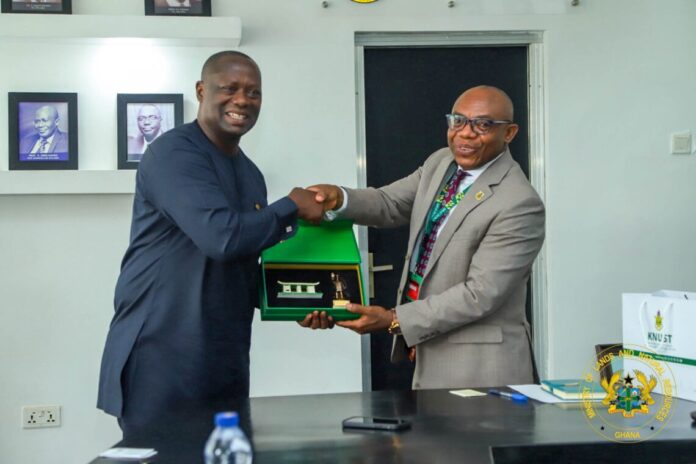
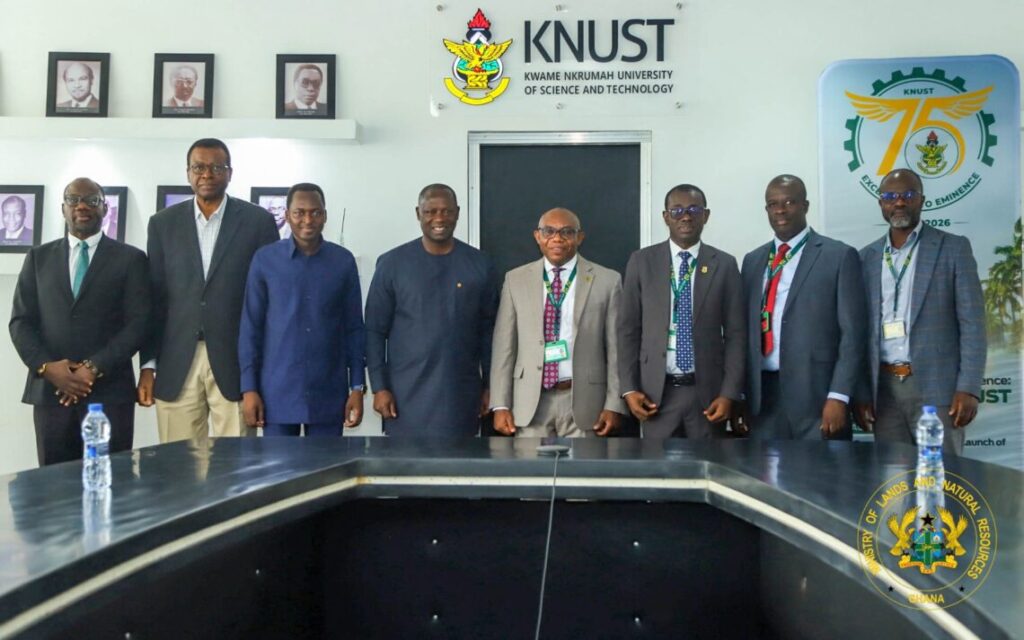
The proposal followed high-level deliberations between KNUST Vice-Chancellor, Professor Christian Agyare, and the Minister for Lands and Natural Resources and Member of Parliament for Ellembelle, Emmanuel Armah-Kofi Buah.
Mr Buah paid a working visit to the university on Tuesday, November 3, 2026, as part of his sustained engagements with the institution. During the visit, he donated a Financial Technology (FinTech) laboratory to bolster the university’s Engineering Department and reinforce its technological capabilities.
The proposed satellite campus is envisaged to widen the frontiers of higher education in Nzema and its adjoining communities, while consolidating KNUST’s institutional footprint in the Western Region, particularly within Ghana’s strategically important oil and gas corridor.
Professor Agyare disclosed that the proposed establishment could transcend geographical limitations by extending its academic reach to neighbouring French-speaking West African countries, potentially transforming Nzema into a regional hub for intellectual advancement, specialised skills acquisition, scientific research and technological innovation.
He further emphasised that the initiative would afford young people in the Western Region greater opportunities to pursue higher education without necessarily travelling long distances to access tertiary institutions.
KNUST, Lands Ministry pursue technology-driven natural resource governance
Beyond the proposed satellite campus, the engagement also explored a broader strategic partnership between KNUST and the Ministry of Lands and Natural Resources, with particular emphasis on deploying scientific research, technological ingenuity and academic expertise to strengthen Ghana’s natural resource governance.
Artificial Intelligence (AI), Mining Engineering and Financial Technology (FinTech) emerged as critical areas of deliberation.
The discussions examined how emerging technologies could revolutionise operational efficiency, reinforce surveillance and monitoring mechanisms, and facilitate more informed decision-making within the natural resources sector.
Particular attention was also devoted to the deployment of FinTech systems in monitoring and evaluating natural resource management, with the potential to entrench transparency, institutional accountability and administrative efficiency.
The collaboration is expected to leverage KNUST’s formidable research capabilities and technical proficiency to enhance the monitoring and sustainable management of Ghana’s forests, water bodies and mineral extraction activities.
Partnership to reinforce Ghana’s anti-galamsey campaign
The proposed institutional collaboration comes against the backdrop of intensified national efforts to confront illegal mining, deforestation and the wanton degradation of the country’s critical water resources.
Mr Buah stressed the importance of the partnership, particularly as government seeks more effective and technologically driven interventions to address the persistent threats confronting Ghana’s natural resource endowment.
KNUST’s anticipated contribution is expected to strengthen the scientific underpinnings of the Ministry’s policies and operational interventions, while fostering a more robust interface between academic research, industrial practice and public-sector administration.
The partnership could further facilitate specialised professional training, evidence-based policymaking and the development of innovative interventions to address longstanding challenges in the extractive and environmental sectors.
Satellite campus to immortalise Nkrumah’s enduring legacy
The proposed establishment carries profound historical and symbolic significance, as it seeks to immortalise the contributions of Dr Kwame Nkrumah to Ghana’s independence, industrialisation and educational transformation.
The initiative would connect the ideals of Ghana’s founding President with contemporary aspirations to democratise access to higher education, accelerate scientific advancement and cultivate the technical competencies required for national development.
For the Nzema enclave, the prospect of hosting a KNUST satellite campus represents a potentially transformative educational opportunity, with far-reaching implications for human capital development, regional economic advancement and intellectual empowerment.
Although the proposal remains at the exploratory stage, its eventual realisation could elevate Nzema’s educational standing and position the area as an important destination for academic excellence and technological innovation.
The initiative, if actualised, would not only broaden the geographical reach of one of Ghana’s premier tertiary institutions but also give renewed expression to Nkrumah’s enduring conviction that education, science and technology are indispensable instruments of national transformation.