
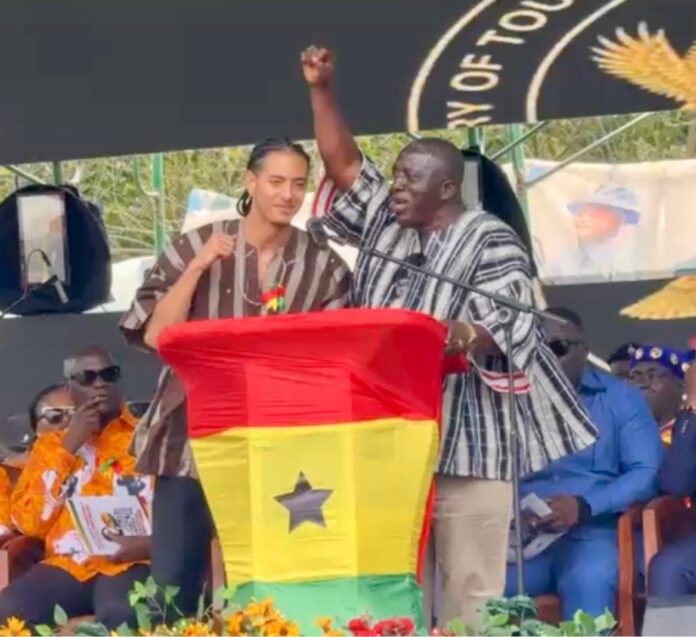

The annual commemoration of Osagyefo Dr Kwame Nkrumah must evolve beyond ceremonial pageantry, evocative speeches and nostalgic tributes into a sustained national commitment to the ideals that underpinned Ghana’s independence struggle, the Omanhen of Essikado, Nana Kobina Nketsiah V, has advocated.
According to the Paramount Chief of the Essikado Traditional Area, Nkrumah’s enduring philosophy must be deliberately integrated into Ghana’s educational system to ensure that succeeding generations do not merely learn about the country’s first President but imbibe the principles that defined his vision for Ghana and Africa.
Nana Nketsiah made the call during this year’s Nkrumahfest, arguing that acquainting the youth with Nkrumah’s worldview could cultivate a generation distinguished by patriotism, selflessness, intellectual consciousness and an unwavering commitment to national development.
“When such an opportunity is given to the younger generation to imbibe this state of being, there is a strong affirmation and awareness that will make them grow into selfless, committed, and patriotic citizens,” Nana Nketsiah told the gathering.
“We cannot develop and be free if our hands are tied by our oppressors. Nkrumah came to fight oppression.”
The preservation of Nkrumah’s legacy, for Nana Nketsiah should not be confined to monuments, anniversaries and historical narratives but must find practical expression in the education and civic orientation of the Ghanaian child.
The Paramount Chief’s proposition reflects a central tenet of Nkrumah’s political philosophy: that political independence, in isolation, could not guarantee genuine emancipation unless accompanied by intellectual liberation, economic self-reliance and the cultivation of a new consciousness among Africans.
Nkrumah, in his writings and public addresses, envisioned the emergence of a “new African personality” characterised by courage, selflessness, discipline and resistance to every form of domination.
Nana Nketsiah believes those attributes remain indispensable to Ghana’s quest for sustainable development and national cohesion.
The Essikado Omanhen also drew a connection between Nkrumah’s philosophy and the contemporary discourse on integrity, accountability and public morality.
He argued that the courage to uphold truth, even when it is politically or socially inconvenient, remains fundamental to the preservation of national integrity.
Nana Nketsiah invoked Nkrumah’s oft-cited description of the ideal African citizen as “a new type of citizen, dedicated, modest, honest and informed… a man who abhors greed and detests vanity.”
The Paramount Chief further pointed to Nkrumah’s personal example after leaving office, arguing that the former President’s approach to public service offers an enduring reference point in discussions about leadership and personal enrichment.
For him, Nkrumah’s aversion to greed and corruption should not be treated as an antiquated political doctrine but as a principle capable of informing contemporary governance and civic responsibility.
“Each year we gather for Nkrumah. We hear the usual speech recitals, and then we return to our normal lives. So what’s next after this programme?” he asked.
“Are we going to carry on with our normal life, or live the thoughts and ideals of Osagyefo?”
His intervention introduces a broader question about the practical meaning of commemorating Nkrumah in contemporary Ghana.
Nkrumah’s political legacy encompasses a broad spectrum of ideas, including industrialisation, mass education, African unity, economic independence and the liberation of the continent from colonial domination.
Consequently, the preservation of that legacy arguably demands more than the annual invocation of his name. It requires a sustained interrogation of how the principles he espoused can be adapted to the exigencies of modern Ghana.
More than six decades after independence, Nkrumah remains an indelible figure in Ghana’s political history and in the wider intellectual tradition of African liberation.
His name adorns streets, institutions and monuments, while his speeches and writings continue to stimulate scholarly and political discourse across the continent.
Yet the reflections at Nkrumahfest point to a more profound measure of legacy: not merely how frequently Nkrumah is celebrated, but how faithfully the values associated with his vision are reflected in the conduct of citizens and the institutions of the state.
The enduring challenge, therefore, is to transform remembrance into conviction, rhetoric into practice and commemoration into a living national ethos.