

Two officers of the Ghana Immigration Service (GIS) have been directed to refund unearned salaries totalling up to GH¢57,006 by November 7, 2026, following the exposure of payroll irregularities contained in the Auditor-General’s reports.
The officers, identified as Abida Zakaria and Abora Angelina, have been notified to reimburse the state, while officials who sanctioned the disputed payments risk being held financially accountable should the recovery exercise prove unsuccessful.
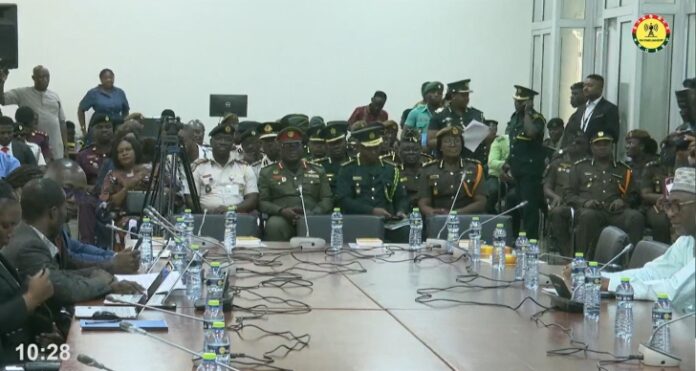
The matter surfaced on Tuesday, October 20, 2026, when the Minister for the Interior, Muntaka Mohammed-Mubarak, led a delegation of Immigration Service officials before Parliament’s Public Accounts Committee (PAC) to respond to queries arising from financial irregularities identified in the Auditor-General’s reports.
Addressing the committee, Mr Muntaka disclosed that the two beneficiaries had been formally notified to refund the amounts, cautioning that the ministry would pursue the officials responsible for authorising the payments if the November 7 deadline elapsed without full recovery.
The revelations have intensified scrutiny of payroll administration, internal controls and the enforcement of financial accountability within the country’s security institutions.
In a bid to rectify administrative deficiencies and forestall further financial irregularities, Mr Muntaka announced plans to introduce a new human resource management software system to strengthen personnel administration and enhance salary verification within the Immigration Service.
He explained that personnel data was being uploaded onto the system, which is expected to facilitate the prompt updating of staff records whenever officers are transferred between management units.
According to the minister, delays in updating personnel information have occasionally resulted in supervisors at former stations continuing to validate the salaries of officers who had already been reassigned.
In certain instances, supervisors relied on information from colleagues at receiving stations before discovering that an officer had resigned or absconded, exposing weaknesses in the existing verification procedures.
Mr Muntaka said the proposed digital system was intended to eliminate such administrative loopholes, improve the integrity of personnel records and minimise the risk of disbursing public funds to ineligible beneficiaries.
The committee also scrutinised GH¢37,907 in excess salary arrears paid to seven Immigration Service officers, as documented in the Auditor-General’s report.
Providing an update on the recovery exercise, Mr Muntaka disclosed that approximately GH¢24,900 had been retrieved, leaving an outstanding balance of about GH¢12,900.
Although the ministry was pursuing the remaining amount, the minister appealed for leniency regarding interest charges, particularly in cases involving newly recruited officers who might not have fully comprehended the calculations underpinning their salary adjustments.
The committee chairperson, however, maintained that beneficiaries bore a responsibility to interrogate payments that appeared excessive, especially when they had received official correspondence explaining the adjustments to their remuneration.
Mr Muntaka acknowledged the need for more rigorous scrutiny of the procedures governing the computation and disbursement of salary arrears to prevent similar financial discrepancies.
In a separate matter, the committee examined efforts to recover GH¢206,085 from an Immigration Service inspector who reportedly resigned after spending four years on study leave with pay.
The Auditor-General had recommended that the principal amount, together with applicable interest, be recovered after the officer allegedly failed to fulfil the requisite service obligations attached to the study leave.
Mr Muntaka informed the committee that the ministry had contacted the former officer, who had expressed a willingness to settle the outstanding debt. The individual had consequently been given until the end of October 2026 to fulfil the repayment obligation.
The minister further cautioned that officials who authorised the study leave could be held financially liable if the money could not be recovered from the former officer.
He added that the ministry had commenced a review of compliance with study-leave requirements, including admission conditions and the submission of academic transcripts, to ensure that officers adhered to the terms governing such arrangements.
The committee also interrogated salary payments made to an Immigration Service officer, Modestus Komla Goloh, who failed to resume duty after his leave expired on August 27, 2024.
Despite his absence, the officer received GH¢7,737.68 in salary payments for September and October 2024.
Mr Muntaka told the committee that the amount had been recovered with interest, with a representative of the Auditor-General confirming that GH¢9,246.26 had been paid.
The cases collectively highlight persistent vulnerabilities in payroll management, personnel verification and the recovery of public funds within the security services.
The committee’s scrutiny is expected to reinforce calls for stricter financial controls, more efficient personnel monitoring and greater accountability among officials entrusted with the administration of public resources.
Ghana Immigration Service (GIS), Muntaka Mohammed-Mubarak, Public Accounts Committee, PAC hearing, GH¢57,006, Auditor-General, Abida Zakaria, Abora Angelina, public financial accountability,