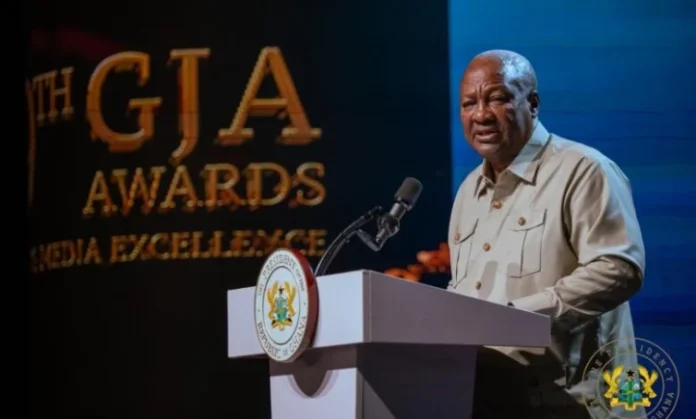

President John Dramani Mahama has announced plans to allocate GH¢10 million in the 2027 Budget as seed capital for the Media Development Fund, in a strategic intervention aimed at bolstering journalists’ welfare, enhancing professional capacity and strengthening Ghana’s media landscape.
The President made the announcement at the 30th Ghana Journalists Association (GJA) Media Awards held in Accra on Saturday, November 7, 2026.
The prestigious ceremony, chaired by the Ga Mantse, King Tackie Teiko Tsuru II, was held under the theme, “Celebrating Excellence, Advancing Media Freedom, and Combating Hate Speech in the Digital Age.”
The proposed allocation is expected to be captured in the 2027 Budget Statement, scheduled for presentation to Parliament on Thursday, November 12, 2026.
President Mahama explained that the fund would provide critical financial support for journalists’ welfare, investigative reporting, professional training, digital literacy and safety programmes.
He recalled that he first announced plans to reactivate the fund at the 29th GJA Media Awards, emphasising the necessity of mobilising additional financial resources from corporate institutions to ensure its long-term sustainability.
“I shall personally work with the GJA to get several other corporate institutions to contribute to the fund,” he assured.
The President specifically appealed to the KGL Group and the Bank of Ghana to support the initiative, urging corporate entities to demonstrate their commitment to the advancement of journalism in the country.
“So KGL, Bank of Ghana, all of you, we’re coming to you to contribute to the media fund,” he stated.
He further assured that his administration would collaborate with the GJA and other relevant institutions to provide tangible assistance to media practitioners while safeguarding editorial autonomy and journalistic independence.
On the safety of journalists, President Mahama reaffirmed the imperative of protecting media practitioners against intimidation, censorship and unwarranted interference, insisting that they must be afforded the latitude to investigate and publish matters of public interest without fear.
He stressed that threats, physical assaults and deliberate obstruction of journalists in the execution of their professional responsibilities must attract prompt and impartial investigations.
The President expressed particular displeasure with the conduct of some security personnel, whom he accused of harassing journalists under the guise of asserting authority.
He disclosed that he had engaged the leadership of the GJA and commanders of the various security agencies over the matter, assuring that his administration would not countenance unjustified attacks on media practitioners.
“We’ll continue to take action whenever a media person is unfairly assaulted while performing their duties,” he declared.
President Mahama also paid tribute to murdered investigative journalist Ahmed Hussein-Suale, describing his killing as a painful testament to the dangers confronting journalists who undertake sensitive investigative assignments.
He reiterated that the bereaved family deserved justice, stressing the need to ensure accountability over the tragic incident.
“His family deserves justice,” he said.
The President subsequently commended Ghana’s improved performance in the 2026 World Press Freedom Index published by Reporters Without Borders, with the country advancing from 52nd to 39th position among 180 countries.
He pledged to work assiduously with the GJA to consolidate the achievement and preserve an environment conducive to independent journalism.
Turning his attention to the proliferation of misinformation and disinformation in the digital space, President Mahama cautioned that fabricated narratives could reach thousands, and even millions, of unsuspecting individuals before factual clarification became available.
He cited a viral video depicting residents in Liberia exposing substandard road construction, which was subsequently circulated in Ghana with an altered voice-over to create the false impression that the incident had occurred locally.
He also expressed apprehension about the growing weaponisation of artificial intelligence to manufacture deceptive images, fabricated recordings and fraudulent investment advertisements, including content falsely portraying him as endorsing investment schemes.
According to him, several individuals had contacted him to authenticate the recordings, illustrating the increasingly sophisticated nature of digital deception.
The President disclosed that he had tasked the Media Foundation for West Africa and the GJA to undertake extensive consultations and submit recommendations on measures to address the complexities of the evolving media ecosystem.
He called for a comprehensive national conversation on the distinction between constitutionally protected expression, hate speech and outright abusive communication.
“We must as a society agree on where we draw the line between free speech, hate speech, and outright insults,” he stated.
He, however, cautioned that any measures adopted to address credible threats or incitement to violence must remain lawful, proportionate and firmly anchored in due process.
Beyond media freedom and digital accountability, President Mahama challenged editors and media proprietors to recalibrate their editorial priorities by giving greater prominence to socioeconomic issues affecting ordinary Ghanaians.
He argued that the media must move beyond the excessive preoccupation with partisan political exchanges and amplify issues confronting farmers who lose their produce because of deplorable road networks, mothers compelled to travel considerable distances to access healthcare and young people struggling to secure employment after completing their apprenticeships.
The President criticised the proliferation of politically charged morning radio discussions, where party representatives debate subjects ranging “from animal science to nuclear power”, arguing that although such exchanges might entertain audiences, they often fall short of providing meaningful public education.
He consequently urged media organisations to embrace more substantive developmental journalism capable of influencing public discourse, exposing institutional deficiencies and amplifying the concerns of underserved communities.
President Mahama also admonished media practitioners and media houses to demonstrate greater editorial accountability by promptly retracting inaccurate publications and issuing unreserved apologies whenever erroneous reports undermine the reputations of individuals or institutions.
He expressed concern about the reluctance of some media organisations to acknowledge professional shortcomings, insisting that the willingness to admit mistakes was indispensable to responsible journalism and public trust.
The President further encouraged veteran journalists and experienced editors to institutionalise mentorship programmes that would equip younger practitioners with the requisite knowledge, technical proficiency and professional discipline to excel in the industry.
He also criticised what he characterised as excessive media zealotry, particularly instances in which journalists publicly challenged ministers to appear on their programmes to account for alleged discrepancies.
While acknowledging the media’s constitutional responsibility to scrutinise public officials and demand transparency, he cautioned against the deliberate pursuit of controversies where none existed, arguing that such practices could divert national attention from pressing developmental priorities.
He equally reminded public officials that accountability must be reciprocal, urging government appointees to demonstrate candour and transparency when confronted with difficult questions, just as they readily publicise their accomplishments.
Reaffirming his administration’s commitment to press freedom, President Mahama assured journalists that the government would respect their constitutional mandate, irrespective of the intensity of their scrutiny.
“We will uphold your right to exercise your mandate, even when you ask us the most difficult questions,” he assured.
The proposed GH¢10 million allocation is expected to provide an initial financial foundation for the reactivation of the Media Development Fund, with corporate participation and institutional collaboration expected to complement government’s contribution towards strengthening journalism and safeguarding the professional welfare of media practitioners in Ghana.