
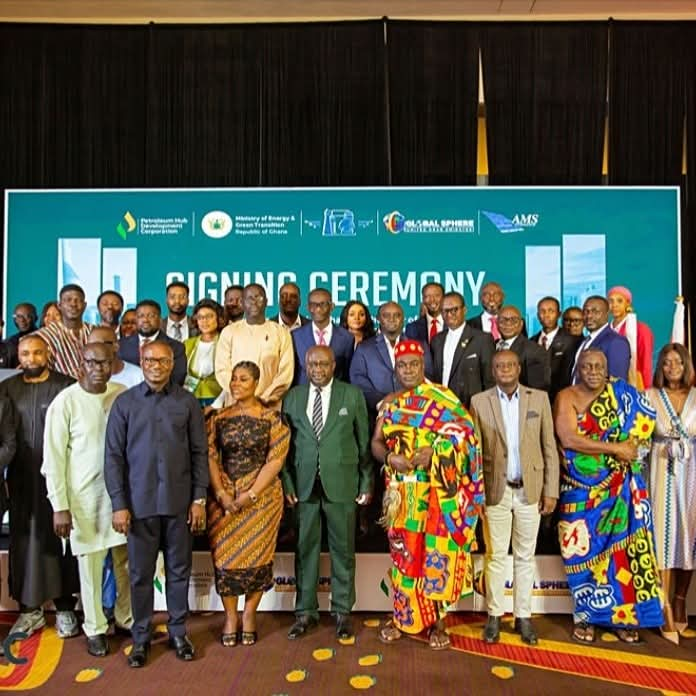

Ghana’s industrialisation ambitions have received a substantial boost following the signing of a $28 billion Build-Own-Operate (BOO) agreement for the second phase of the Ghana Petroleum and Petrochemicals Hub, with Jomoro in the Western Region poised to emerge as a strategic epicentre of petroleum refining and petrochemical production.
The Petroleum Hub Development Corporation (PHDC) signed the Investment and Land Development Agreement in Accra with a Korea-Emirati-Mali consortium spearheaded by Global Sphere, setting the stage for the development of a 300,000-barrel-per-stream-day refinery, two petrochemical plants, storage infrastructure with a capacity of four million cubic metres, and a multi-berth jetty.
The consortium is expected to execute the project within five years, with construction scheduled to commence in the first quarter of 2027, subject to the resolution of any technical impediments.
The ambitious undertaking is expected to reinforce Ghana’s petroleum-processing capabilities, stimulate industrial expansion, generate employment and strengthen the country’s position as a prospective supplier of refined petroleum products to the wider West African market.
The signing ceremony attracted an array of government officials and traditional authorities, including the Minister of Lands and Natural Resources and Member of Parliament for Ellembelle, Emmanuel Armah-Kofi Buah; Deputy Minister of Transport and MP for Jomoro, Dorcas Affo-Toffey; Western Regional Minister Joseph Nelson; President of the Western Regional House of Chiefs, Nana Kobina Nketsiah V; and Paramount Chief of the Western Nzema Traditional Area, Awulae Kwasi Amarhchi III.
Addressing the gathering, the Minister of Energy and Green Transition, Dr John Abdulai Jinapor, reiterated the government’s determination to maximise the economic dividends of Ghana’s petroleum endowment through domestic processing and value addition.
He disclosed that the country’s oil production was beginning to rebound after five consecutive years of decline, citing a $1.5 billion framework agreement with ENI, a $2 billion agreement with Jubilee Partners and ongoing deepwater drilling campaigns as part of efforts to revitalise the upstream petroleum sector.
Dr Jinapor maintained that expanding crude oil production without developing corresponding processing infrastructure would undermine Ghana’s quest to derive optimal value from its natural resources.
“But the vision of the President is simple. We cannot increase oil production without adding value to that oil resource. And that is why the Petroleum Hub represents a very, very key element in the whole value chain,” he stated.
The minister described the proposed refinery’s 300,000-barrel-per-day capacity as formidable, emphasising that its operational scope would extend beyond Ghana’s domestic requirements to serve the broader West African sub-region.
“So to process 300,000 barrels would mean that you are not just feeding Ghana, that you are satisfying the rest of the sub-region,” he added.
Dr Jinapor consequently pledged the government’s unwavering support for the initiative, assuring the consortium that he would collaborate with relevant ministries to facilitate the fulfilment of the state’s obligations and advance the project towards implementation.
Representing the investment consortium, Boubacar Belco Bah described the agreement as a defining step towards industrial transformation, enhanced economic cooperation and the establishment of enduring commercial partnerships.
“Today’s agreement represents a defining moment in our collective pursuit of industrial advancement, strategic cooperation and shared prosperity. We are laying the foundation for an industrial transformation with the potential to benefit Ghana, strengthen West Africa, and create opportunities for generations to come,” he said.
Mr Bah observed that African economies had historically exported valuable natural resources while importing finished products that could be manufactured domestically through strategic investment in industrial infrastructure.
He argued that the Petroleum Hub presented Ghana with an opportunity to reverse this pattern by strengthening domestic processing capacity, expanding industrial production and retaining a greater proportion of the economic value generated from its petroleum resources.
He disclosed that the Global Sphere-led consortium and its development partners were advancing investment mobilisation and financial structuring for Phase II, including strategic equity participation, long-term debt financing, credit enhancement and risk-mitigation arrangements.
However, Mr Bah clarified that the agreement did not signify the completion of the financing process, describing it instead as a crucial step towards securing the capital required to execute the project.
“Ultimately, our success will be measured not by the agreement we sign today, but by the commitments we honour and the results we achieve together,” he stressed.
He further indicated that the project would complement the government’s 24-Hour Economy and Accelerated Export Development agenda, while unlocking economic opportunities for Jomoro and neighbouring communities.
According to him, the consortium intends to promote local employment, vocational and technical training, supplier development and the participation of Ghanaian enterprises throughout the project’s value chain.
The Chief Executive Officer of PHDC, Dr Toni Aubynn, disclosed that the agreement followed 580 days of work since he assumed office, describing the period as one characterised by meticulous preparation, investor engagement and an unwavering determination to translate the Petroleum Hub vision into reality.
“None of us had built a petroleum hub before. However, given the depth of professional expertise within the staff, we set out to match the realisation of this project’s vision with preparation, an unflinching resolve to attract investors, and the determination to get this project off the ground,” he said.
Dr Aubynn noted that 2026 had been designated the Year of Action, adding that the corporation had laid the groundwork for attracting investors and advancing the project towards implementation.
He expressed appreciation to President John Dramani Mahama for his commitment to the initiative, particularly following what he described as a pivotal meeting in November 2025. He also acknowledged the contributions of the sector minister, his deputy, Richard Gyan-Mensah, and other individuals and institutions involved in advancing the project.
The PHDC chief executive maintained that the initiative’s ultimate success would be determined by the infrastructure delivered, investments secured, employment opportunities created and enduring economic benefits generated for Ghanaians.
“Today, we celebrate.
“Tomorrow, we return to work, united in purpose and determined to turn this commitment into reality,” he added.
The proposed facilities at Jomoro are expected to enhance Ghana’s capacity to transform crude oil into finished petroleum products, potentially reducing dependence on imported refined fuels while expanding opportunities for petrochemical manufacturing and exports.
Beyond the immediate benefits to the energy sector, the project could stimulate ancillary industries, strengthen domestic supply chains and create new opportunities for skilled professionals, technicians, contractors and local businesses.
However, the actualisation of these projections will depend on the consortium’s ability to secure the requisite financing, fulfil its contractual obligations and adhere to the proposed implementation schedule.
With construction anticipated to begin in the first quarter of 2027, attention will now shift to the completion of financing arrangements and the commencement of physical works at the project site.
If successfully executed, the $28 billion undertaking could become a major component of Ghana’s industrialisation drive, positioning Jomoro as a strategic petroleum-processing destination and strengthening the country’s capacity to serve the energy and petrochemical needs of the wider West African market.